I've been needing some good cold-weather running gear for years, so I was excited yesterday when my new merino wool socks and quarter-zip base layer arrived. I especially like the base layer, which is soft, breathable, and odor-resistant. It's also black and fits pretty sleekly. In my own mind, it gives me a smoky George Harrison Quiet Beatle loved-him-a-black-turtleneck kinda look. I checked in with Mom seeking some words of affirmation, more specifically, how hot I looked in the new shirt. Mom's response: "Black is a good color on you." Which is not exactly a rejection of my bid but is certainly no better than neutral. Mom subsequently confirmed, as I suspected, that she didn't want to tell me I'm hot in front of our boys, who were quite amused by our exchange.
Showing posts with label Breakfast. Show all posts
Showing posts with label Breakfast. Show all posts
Sunday, January 11, 2026

Sunday, September 14, 2025
Twenty years too late
Remember when Mom used to roll out that chart of y'all's chores for the week, and you used to moan and groan about it? Well, there's scientific proof that she was doing you ingrates a favor, even if it did come 20 years too late.
For example, three doctors [1] from the University of Virginia Children's Hospital (Go Hoos!) analyzed data from almost 10,000 children entering kindergarten in 2010 to 2011. The kids' parents reported how often their children did chores. When the kids were in the third grade, they responded to a questionnaire regarding their perceived interest or competence in academics, peer relationships, prosocial behavior, and life satisfaction. They also completed direct academic assessments for reading, math, and science. The doctors analyzed the data and found, among other things, that "[t]he frequency of chores in kindergarten was positively associated with a child's perception of social, academic, and life satisfaction competencies in the third grade, independent of sex, family income, and parent education," and that "[p]erforming chores with any frequency in kindergarten was associated with improved math scores in the third grade." This led the UVA docs to conclude that "performing chores in early elementary school was associated with later development of self-competence, prosocial behavior, and self-efficacy."
Sunday, April 13, 2025
It never gets old
The book sale ends today, though it's long since been picked clean by the final half-price Sunday. This year, Cassie and JC came for the FotL member pre-sale on the Friday evening before the book sale's official start on Saturday morning at 10:00 AM. Everyone did pretty well, though Mom took the prize as usual with not one but two big bags of books. Mom didn't want to take the time to line her purchases up nice and neat, so you won't see her piles below. But here are photos of the stacks of books that Cassie, JC, and I picked up. Can you match the stack with the book buyer?

Sunday, February 9, 2025
Pizza Day!
It's a big day today! No, not the Super Bowl, who cares about that? It's National Pizza Day! (And apparently World Pizza Day too.) I tried to make a big deal last year, but everyone pooped on my pizza parade. This year I insisted though, and Dylan was on board because pizza is his favorite food, which got the ball rolling. So I made Shortcut Sicilian-Style Italian Pizza:

Saturday, December 17, 2022
Flour is raw
In a somewhat bizarre development, Wegmans is now stamping the tops of the bags of flour it sells with a warning that "Flour is raw. Please cook fully before enjoying." As you we used to say in high school, "no shit, Sherlock." Be warned, all you eaters of raw cookie dough.

*********
Saturday, October 15, 2022
Fast food, episode XII
I hear you: "Good grief, do we really need another recipe for scrambled eggs?" Well, thank you for asking, because yes, yes you do. This one is the easiest, quickest, and maybe tastiest of all, with no added dairy or extra yolks to make them richer. Brad watched me make these and couldn't believe how quick and easy it was; so quick and easy that he started having them for breakfast every day. Five minutes to make enough yummy protein to satisfy even JC (for an hour or two anyway). 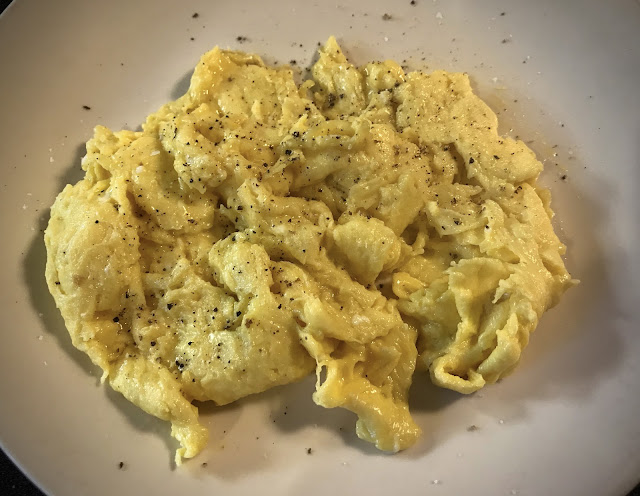

Quickest Scrambled Eggs
Time: 5 minutes (for 2 eggs)
For 8 eggs (serving 4), use 2 tablespoons (27 grams) oil, ¾ teaspoon kosher salt, and a 12-inch nonstick skillet.
1 tablespoon (13 grams) extra-virgin olive oil
2 large eggs (~57 grams each still in the shell)
Scant ¼ teaspoon Diamond Crystal kosher salt
Freshly ground black pepper
1. In an 8-inch nonstick skillet, heat the oil over medium heat (maybe a notch or so above medium on an electric burner) until shimmering and just starting to smoke, about 3 minutes.
2. Meanwhile, crack the eggs into a small bowl and add the salt. Whisk until homogeneous, loose, and frothy.
3. When the oil is ready, pour the eggs into the center of the pan. Using a silicone spatula, push the egg from the sides of the pan toward the middle until the egg starts to firm up around the edge, then start folding over onto itself until the eggs are just set but still shiny, wet, and soft. This only takes up to 60 seconds for 2 eggs (60 to 90 seconds for 8 eggs). Transfer immediately to a waiting plate, where the eggs will finish cooking. (If the eggs are completely done in the pan, they'll be overcooked on the plate.) Season to taste with salt and pepper. Serve promptly. Serves 1.
Tuesday, June 14, 2022
I missed my calling
The New Yorker recently ran a short profile of Taylor A. Humphrey, a 33-year-old N.Y.U. graduate and "professional baby namer." Running between $1,500 and $10,000, her services include: generating a bespoke [1] list of names based on parents' responses to a questionnaire; a genealogical investigation to uncover old family names; and even coming up with a name that will be "on-brand" with a parent's business, because naming your kid should be about moving more merchandise, right?
The author sits in on Humphrey's phone call with one client who clearly has too much disposable income. Right away they start weeding out names that are definite nonstarters, including Bodhi, which is a massive letdown. But they do put Brave on the "maybe" list, at least as a middle name. As they whittle down the list, Humphrey urges her client not to pass on Stellan, which apparently means "peaceful and calm." But the client, who is a World War Two buff, is rightfully dubious because Stellan "sounds a lot like Stalin." No word on whether Humphrey is also a fan of Hettler or Mussaleni as baby names. However, another article about Humphrey points out that she is a big fan of the names of Elon Musk's children: X Æ A-12 (a son nicknamed X) and Exa Dark Sideræl (a daughter nicknamed Y). [2]
Anyway, I'm thinking this baby-naming thing can't be all that hard, and it's not like I'm a complete novice. So, the next time you know someone who needs help naming their kid, tell them to wire me a grand (cheap!) and I'll send them a bespoke list of awesome names that don't sound anything like any of history's worst mass murderers or include the æ diphthong.
---------
[1] This is a trendy word that seems to pop up in every third article I read nowadays. It means custom-made. It's a decent word, but let's face it, it's not callipygian.
[2] You may not inherit $300 billion from Mom and me, but there are some benefits to being our children.
*********
Saturday, January 22, 2022
Reevaluating
I recently discovered that Christina Tosi is a JMU grad. She actually spent a year at UVA (studying electrical engineering!) before transferring to JMU and enrolling in the Semester in Florence program (!!) before graduating in 2002 with a degree in applied mathematics (!!!) and Italian (!!!!). Tosi reevaluated after JMU and decided that she wanted to be a pastry chef, after asking herself "What is it that you can do every single day for the rest of your life?" and answering "Make cookies." (And cakes, including the incredible funfetti cake that I simplify and make for Mom's birthday.)
Saturday, December 4, 2021
Use a microwave, episode II
When Brad got home for his week off for Thanksgiving, he took Carter's famous "Don't have to" to the next level. Not long after he arrived, Mom said we were going to need some help with three visitors here and she'd start assigning chores. Brad immediately put the kibosh on that idea, loudly announcing that "I ain't doin' squat!" Mom remembered that we never did squat either when we visited Grandma Pina and Grandpa Guy and how much we appreciated the break. Of course, neither of us dared to proclaim "We ain't doing squat!" when we got there, but I guess we didn't have to, because Grandma Pina wasn't about to let us lift a finger anyway. So now Mom knows just to keep her list of chores to herself when you visit. You can thank your little brother for that one.
*********
Thursday, November 25, 2021
Guest Post #2: Dylan's turn
Moriah and I cooked these two recipes for Mom, Dad, and Brad while they were visiting me in Seattle in July, and they were such a hit that Dad asked me to write them up for a blog post. Cass and Jancalo couldn’t escape Florida and Virginia, respectively, to make it out here for a visit, but maybe they’ll cook these recipes from the blog.
These quesadillas are a meal-prep staple for Moriah and me, and we frequently make the hash for brunches. The quesadillas are inspired by a stall at the farmer’s market. They were so good that one day we asked about the basic ingredients and flavorings; it turns out that these quesadillas are simple as well as delicious, so we bought some produce and cheese, went home, and made them ourselves. The hash is similar. Moriah’s roommate Toby brought an excellent hash to brunch, so we asked him how he made it then made it ourselves for the next brunch.
Sunday, November 14, 2021
Coffee options, episode II
Here is an easy way to take your morning granola to the next level. Dissolve a little bit of cocoa powder and turbinado sugar in a hot espresso. Let that cool, then mix it into a container of yogurt. Voilà, mocha yogurt, with just a hint of sweetness and caramel notes from the turbinado. Mom and I both thought this qualified as "heavenly" when mixed up with some Granola 2.0. I bet it would also amp up smoothies and Sua Chua Cafe, but I haven't tried it in either of those yet.


Mocha Yogurt
Adapted from Maria Speck via her blog (May 26, 2016)
Time: ~10 minutes (using the moka pot method to make the espresso), plus 5 minutes for the coffee to cool down
You can substitute 40 grams (2 tablespoons) of maple syrup for the turbinado sugar.
25 grams (2 tablespoons) turbinado sugar (see note)
8 grams (1½ tablespoons) unsweetened cocoa powder
35 grams (2½ tablespoons) freshly brewed hot espresso or strong coffee
16 ounces/454 grams (~2 cups) whole or low-fat Greek or regular yogurt
1. Measure the sugar and cocoa into a small mug or teacup. Pour over the hot espresso. Mix well with a fork or small whisk until the sugar is dissolved and the cocoa is smooth. Cool to room temperature in the fridge for 5 minutes.
2. Stir the coffee mixture into the yogurt until homogenous. There is just enough room to do this in a 16-ounce container of yogurt if you're careful. Store in the refrigerator. Top with granola for a breakfast treat.
Saturday, November 13, 2021
Use a microwave, episode I
I've always liked the convenience of the microwave for making some actual food, rather than just reheating leftovers.* For example, it's a great shortcut for cooking the potatoes partway for gnocchi. But some things I love are cooked start to finish in the microwave, including what is (or at least should be) everyone's favorite Thanksgiving condiment, Dried Cherry Chutney. And it's nice to have the option of a quick-and-easy chocolate mug cake made with pantry ingredients when you're desperate for something sweet. (Apricot marmalade and homemade ricotta are good too.)
Still, I haven't explored the microwave for "real" cooking as much as I should have, even though I've had a classic microwave cookbook—Microwave Gourmet (1987) by Barbara Kafka (50¢ at the book sale!)—on my shelf for years. That's going to change though, now that I've been inspired by Dylan and Moriah sending me the Cooking at Home (2021) book, in which David Chang, in particular, extols the virtues of microwave cooking, including the Microwave Eggplant Parmesan that Moriah wrote up in her guest post. Chang goes so far as to say that he "could not live" without his microwave, which he thinks is "the single best piece of equipment in a kitchen. Here is this machine that will save you 60 percent of cooking time and a bunch of dishes to clean up for almost anything you make," yet it's collecting dust in most American homes. Chang's love for his microwave also led me to the website of Anyday, a manufacturer of high-end microwave cookware designed with Chang's help, which has an extensive collection of simple recipes, a number of which look interesting.
---------
*In addition to reheating leftovers, your microwave is great for a bunch of other kitchen tasks, including: melting chocolate; clarifying butter; caramelizing sugar; toasting dried chiles; making an emergency roux; getting more juice out of citrus (nuke for a few seconds before juicing); releasing flavor compounds in herbs or spices (nuke for a minute in some oil); and mellowing raw garlic (nuke for 10–15 seconds; makes the cloves easier to peel too).
*********
Saturday, August 7, 2021
You can do evil and get off scot-free
If you're wondering what your next (or first) job should be, let me direct your attention to ransomware. In May 2019, the cybercriminals behind the GandCrab ransomware attacks announced they were terminating the program because they had earned so much money (north of $2 billion, with weekly income of $2.5 million) that they could retire on a beach somewhere. Their master plan certainly worked out better for them than it did for Hans Gruber.
But just like Hans Gruber, these criminals had a sense of humor. In their farewell notice, the crooks said:
We ourselves have earned over US $150 million in one year. This money has been successfully cashed out and invested in various legal projects, both online and offline ones. It has been a pleasure to work with you. But, like we said, all things come to an end. We are getting a well-deserved retirement. We are a living proof that you can do evil and get off scot-free. We have proved that one can make a lifetime of money in one year. We have proved that you can become number one by general admission, not in your own conceit
So there it is: You can make a lifetime of money in one year if you choose the right career path. Choose wisely.
*********
And speaking of evil: I've been running with great pleasure past the empty holes where the statutes of Robert E. Lee and Stonewall Jackson used to pollute the views of downtown Charlottesville. Ben Hitchcock, the editor of C-ville Weekly, was apparently having the same thought, because he wrote in the August 4 – 10 issue how glad he was to be able to eat his lunch in what is now Market Street Park (formerly Lee Park) next to the raggedly little garden that has sprouted up where Lee's statute used to be, "rather than in the shadow of a racist monument." In addition to the makeshift garden, Hitchcock also appreciated the sidewalk graffiti reading "Fuck Robert E. Lee and the horse he rode out on." Which proves that graffiti artists can be just as funny as (and have better grammar than) cybercriminals.
*********
Monday, July 26, 2021
A new addition and an old favorite
I used to make these cinnamon buns for you all once in a while when you were little, but it's probably been at least a decade since I made them last. They popped into my head as something different to make when we were bringing breakfast over to Andi and Adam while we met Aubrey (so cute!) for the first time last weekend.
 |
| Just like when you all were babies, but with a lot more gray hair (me, not Aubrey) |
*********
Sunday, June 13, 2021
Strawberry picking
Mom has been picking strawberries every weekend since they came into season. The strawberry season doesn't last long, so Mom likes to strike while the iron is hot. Mom brings home pounds at a time, which leads to the making of many strawberry recipes, including Strawberry Shortcakes and Mom's jam. This year, spurred on by Cassie's unnatural love for Marie's® Raspberry Vinaigrette, I experimented with strawberry vinaigrette. Mom liked it especially well (as with most things), but I wouldn't make it again because, as Brad said, it's not nearly as good as my usual salad dressing.

*********
Wednesday, June 2, 2021
Getcheroni
There was a funny little article by Roz Chast in the April 26 & May 3, 2021 issue of the New Yorker called "Fending." That is the term Chast and her husband use for when they make a meal by picking around the kitchen rather than cooking something or ordering out. (I think of avocado toast as one of the ultimate "fending" meals.) Chast got to wondering what other people call throwing a meal together on the fly like that, so she asked the question on Instagram and got more than 1,700 responses. Some of them were just weird, like fossick and schlunz, while others were pretty clever, like anarchy kitchen. There were several acronyms, one of which I like: YOYO (you're on your own). But my favorite term is probably getcheroni, for the obvious pasta association.
The problem with getcheroni night around here is Mom always wants a salad when we hunt and peck, and it always falls to yours truly to make the salad, so it's no longer really get-your-own-y. We had actually planned a getcheroni dinner last night to deal with a mounting leftover situation. But then Dylan texted me in the afternoon with a link to a recipe for "AMAZING" pumpkin bread. As it turns out, there's a great recipe for pumpkin muffins on UaKS but not one for pumpkin bread. So I couldn't resist, and baking that bread got added to making a salad on my list of no-longer-getcheroni night tasks.
*********
Monday, May 31, 2021
Fractal expressionism
Another one of the cool things I learned about reading The Nature Fix by Florence Williams is what the physicist and painter Richard Taylor has called "Fractal Expressionism." Taylor's term is a play on Abstract Expressionism, the post-World War II American art movement characterized by the use of abstraction, rather than traditional processes, "to convey strong emotional or expressive content." Abstract expressionists include Willem de Kooning, Mark Rothko, Philip Guston, and Jackson Pollock. But Pollock alone makes up Taylor's category of Fractal Expressionism.
It took a physicist and painter to figure this out because "fractals" were discovered by the mathematician Benoit Mandelbrot in the 1970s while looking at a new form of geometry to describe the patterns left behind by the chaotic processes that underlay how natural systems, such as the weather, change with time. As Taylor describes it, fractals "consist of patterns that recur on finer and finer magnifications, building up shapes of immense complexity." Mandelbrot showed that the visual complexity of many natural objects, such as clouds and tree limbs, results from fractal repetition. And many aspects of human physiology are also built on fractals. As Taylor explains in another article, "fractals are so prevalent both inside and outside our bodies that they've earned themselves the dramatic title of being the 'fingerprints of nature.'" Not surprisingly, then, people are drawn to fractals. In fact, fractals of a certain dimension of complexity (measured by a D value between 1 and 2) actually have a physiological effect on people, putting them at ease.
And this is where Jackson Pollock comes in. Incredibly, his method created paintings, like Blue Poles, with D values in the exact range preferred by observers. In other words, Taylor says, Pollock "painted nature's fractals twenty-five years ahead of their scientific discovery" by Mandelbrot.
So, can anyone drip paint onto canvas, like Cassie and Mom did years ago, and produce a fractal expressionist painting that exerts such a draw on people that they are willing to pay up to $140 million for a single painting?

Sorry, but no. Taylor explains that "fractals are not an inevitable consequence of pouring paint but are instead the product of Pollock's particular technique." Contrary to popular belief, Pollock actually had a unique method that involved much more than just splattering blobs of paint onto a canvas. Rather, Pollock "developed a cumulative painting process of returning to his canvas regularly, building layer upon layer of poured paint." This ended up being very similar to nature's processes, such as the Grand Canyon being carved over eons by the Colorado River. Pollock seemed to understand this instinctively, as two of his more famous quotes are that "[m]y concerns are with the rhythms of nature" and "I am nature." (No one says Pollock was self-effacing.) So the next time you're looking at a piece of modern art and some philistine says "my kid could do that," you know the truth.
*********
Sunday, March 21, 2021
The request hour, episode VIII
Another recipe by request, hot on the heels of the tuna salad. I thought the first seven requests had all been from Dylan, but I forgot about the egg quesadilla recipe that Cassie asked me to post when she started cooking for herself. Less than three hours ago, Cassie texted me that I "should put a recipe for breakfast potatoes on the blog." After some clarification from Cassie and Mom that we're referring to home fries, not hash browns, and that Cassie had in mind the home fries that she gets at a certain restaurant in Tallahassee, which are onion-less, unlike many recipes, I did a little research.
Saturday, November 14, 2020
Signature strength #1
While on a mini vacation at the beach, I've been taking every opportunity to exercise my top signature strength (appreciation of beauty and excellence). This evening was especially fruitful. Before Mom and I started on making potato pasta for dinner, we enjoyed this amazing sunset over the Sound:

After the show was over, I ran down to collect some rosemary from the bush in front of the beach house and found these beautiful little flowers blooming all over the bush:
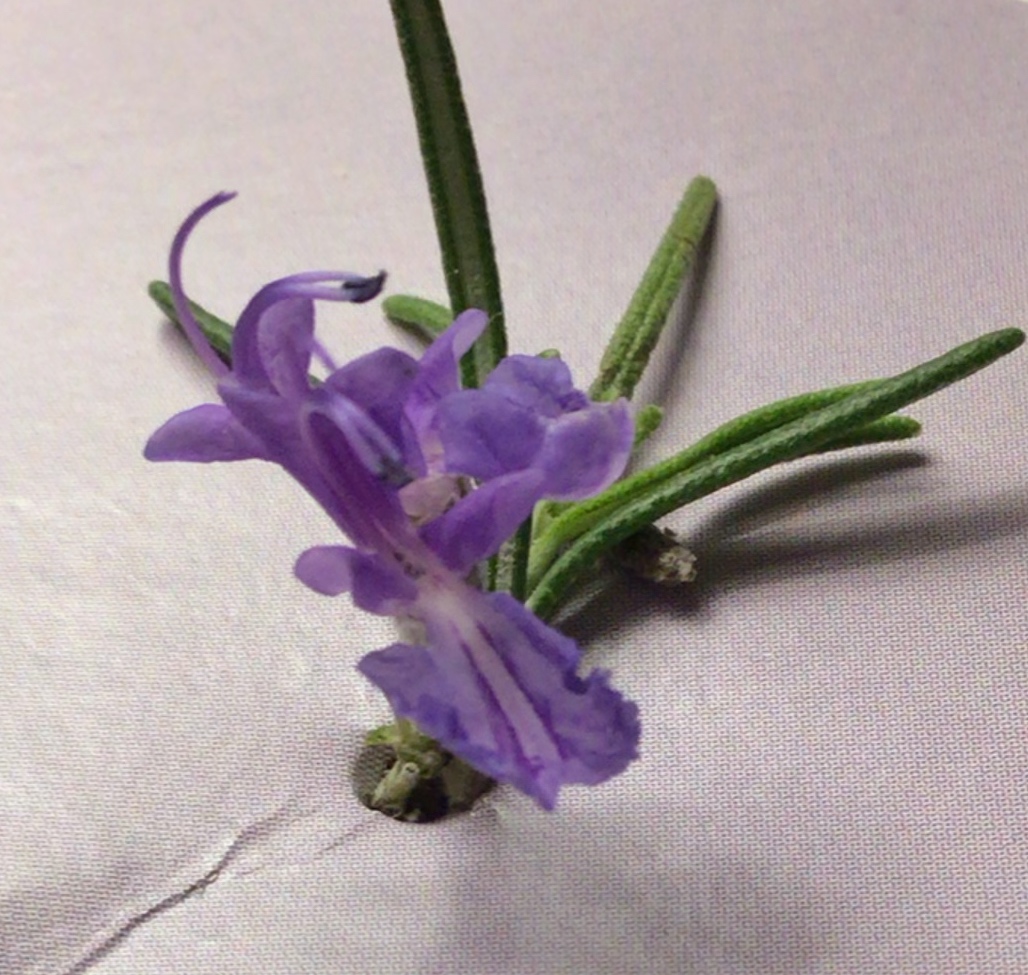
Then the scent of the rosemary permeated the whole house while the potatoes were roasting. My beauty tank is full for the night.
*********
Thursday, October 1, 2020
Lawyering and positive psychology
I just plowed through my latest positive psychology [1] book, The Happiness Advantage (2010) by Shawn Achor. Early in the book, Achor uses lawyers and law students as the poster children for people who can benefit from a good dose of positive psychology. He cites a 2009 article ("Stemming the Tide of Law Student Depression: What Law Schools Need To Learn from the Science of Positive Psychology") by Todd David Peterson and Elizabeth Waters Peterson for the appalling statistic that lawyers are 3.6 times more likely to suffer from a major depressive disorder than the rest of the employed population, putting them (us) at the "unenviable zenith of depressed professionals." The original article includes more eye-opening numbers, such as that 20% to 35% of lawyers are "clinically distressed," as opposed to only 2% of the general population, and that an astounding 70% or lawyers are likely to develop alcohol-related problems over the course of their (our) lifetimes, compared to just 13.7% of the general population. And the problems start in law school, with 44% of law students meeting the criteria for clinically significant levels of psychological distress. "Law students also report significantly higher levels of alcohol and drug use than college and high school graduates of the same age, and their alcohol use increases between their second and third year of law school." These problems are not generalizable to other overworked graduate students, as law students have significantly higher levels of stress, stress symptoms, and alcohol abuse than even medical students. No wonder Achor, who worked at Harvard for years, reports that several Harvard Law School students told him that they often studied at the Education School library because "just being in the same room with other law students, even if no one said a word, spread negative stress like secondhand smoke."
Subscribe to:
Posts (Atom)