Showing posts with label Sides. Show all posts

Sunday, May 10, 2026

Smell-o-Vision


You know how much I love to quote Emeril Lagasse whenever I find a dish that's so flavorful "you could put it on a bumper and it would taste good," or that some dishes are a "food of love thing." One Emerilism I haven't gotten to yet is how he would complain about the limitations of a TV cooking show: “Oooh! I can’t wait till we get Smell-o-Vision so you can smell this at home!”

Friday, March 13, 2026

Drumming is fun

Instead of boring you with another review of some psychological study you probably don't care about (even if you should!), here is a fun video I came across. They filmed Chad Smith of the Red Hot Chili Peppers giving drum lessons to some students after telling them that their regular teacher couldn't make it. I love when one of the kids asks him what it's like playing with the Red Hot Chili Peppers, and Smith gives a long, thoughtful answer before adding that "the chicks and the money is awesome."


********* 
 

Friday, December 12, 2025

Die Hard is most definitely a Christmas movie, episode II

Five years ago, UaKS definitively established that "Die Hard" is, in fact, a Christmas movie. No further proof is required, but we have some more anyway, once again thanks to my buddy Ed:
 

This is a Hans Gruber/Nakatomi Plaza advent calendar. Every day, you move Hans down another floor until he finally goes splat on Christmas Eve.


What better way to usher in and enjoy the true meaning of the Christmas season? Be of good cheer.


 *********
 

Saturday, January 11, 2025

My 2024 reading

A favorite year-end activity is looking through the books I read in the preceding year. According to StoryGraph, I read 73 books in 2024, totaling 21,622 pages. The genre I spent the most time with in 2024 was, not surprisingly, psychology (20 titles), followed by memoir (15), self-help (11), and "literary" (9), whatever that means. Looking through the picture of all the books I read last year, I see that there were a fair number I slogged through, even though they weren't all that enjoyable. 

Saturday, September 24, 2022

My fig crop, episode IV

Our fig tree finally came good this year, producing hundreds of figs, sometimes as many as three dozen in a single day.
 

Mom and I were so excited about this, as we scarfed small but delicious figs every day. Then we went to Italy, where figs were also in season. Here is what they look like in Italy:
 

These figs are much bigger and significantly sweeter and more concentrated in flavor than the brown turkey figs from our tree. Unfortunately, you just can't find anything like these Italian figs in this country. So, I'll still appreciate our tree and the figs it has finally started producing, but I'll always lust after these Italian figs, which are on a whole other plane of awesomeness. And speaking of lust, I can't look at this picture without thinking of this passage from early in Sarah Winman's magnificent novel Still Life:
Yes, I suppose we were, said Evelyn, and she picked up a fig and pressed her thumbs against the soft, yielding skin. I suppose we were, she repeated quietly. She tore the fruit in half and glanced down at the erotic sight of its vivid flesh. She blushed and would blame it on the shift to evening light, on the effect of the wine and the grappa and the cigarettes, but in her heart, in the unseen, most guarded part of her, a memory undid her, slowly—very slowly—like a zip. 
 
*********

Saturday, March 12, 2022

TV is literally shrinking your brain

One of the few benefits of having attended the Johns Hopkins University[1] is getting the quarterly alumni magazine,[2] which usually has a few interesting articles. In the latest issue (Winter 2021), there was a short piece about a study conducted by Ryan Dougherty, a postdoctoral fellow in the Johns Hopkins Bloomberg School of Public Health. Relying on 20 years of data, the study concluded that "[a]mong middle-aged adults, greater television viewing in early to mid-adulthood was associated with lower gray matter volume." In other words, watching TV literally shrinks your brain. By about .5%, as it turns out.
 
The details: Every five years, participants in the longitudinal CARDIA study conducted by the National Heart, Lung, and Blood Institute reported, among other things, the average number of hours of television they had watched on a daily basis during the preceding year. The daily average was 2.5 hours. Those participants who viewed at least an additional 1.4 hours of TV a day[3] showed a half percent reduction in gray matter on an MRI scan performed at age 50. Interestingly, this held true even among people who watched that much TV everyday but who were also above average in the amount of physical exercise they were getting. This suggested to Dougherty that "just becoming more physically active alone is not going to negate the negative effects associated with television viewing."
 
Does it make a difference what kind of programming you're watching? The CARDIA study didn't have information on that, but Dougherty hypothesizes that "documentaries might be less brain-shrinking than reality TV or other fluff." So, no hard data but I'm pretty sure Jeopardy! is way better than The Bachelor.[4] Or just put down the remote altogether and do other activities, such as crossword puzzles[5] or juggling, which other studies have shown may preserve or even add gray matter.

---------
[1] The biggest one being having met your mother there, as if you had to ask.
[2] Which is cleverly titled Johns Hopkins Magazine.
[3] If you don't feel like doing the math, that's a total of 3.9 or more hours a day, which is a lot of fucking TV.
[4] I'm also sticking to my guns that watching soccer games doesn't really count as viewing television.
[5] See if you can work up to a Saturday Stumper in Newsday.
 
*********
 

Saturday, December 4, 2021

Use a microwave, episode II

When Brad got home for his week off for Thanksgiving, he took Carter's famous "Don't have to" to the next level. Not long after he arrived, Mom said we were going to need some help with three visitors here and she'd start assigning chores. Brad immediately put the kibosh on that idea, loudly announcing that "I ain't doin' squat!" Mom remembered that we never did squat either when we visited Grandma Pina and Grandpa Guy and how much we appreciated the break. Of course, neither of us dared to proclaim "We ain't doing squat!" when we got there, but I guess we didn't have to, because Grandma Pina wasn't about to let us lift a finger anyway. So now Mom knows just to keep her list of chores to herself when you visit. You can thank your little brother for that one.
 
********* 

Wednesday, April 28, 2021

Crystallized intelligence favors the old

By a happy coincidence, soon after reading Mindwise and posting the episode musing on whether the decrepitude that sets in with age is less physiology than self-fulfilling prophecy, I read an article ("Starting Fresh" or, if you read it online, "Is It Really Too Late to Learn New Skills?") on lifelong learning by Margaret Talbot in the January 18, 2021 issue of The New Yorker. Talbot discusses three relatively new books, all of which I've added to my ever-expanding library wish list: Beginners: The Joy and Transformative Power of Lifelong Learning (2021) by Tom Vanderbilt; Old in Art School: A Memoir of Starting Over (2018) by Nell Painter; and Late Bloomers: The Hidden Strengths of Learning and Succeeding at Your Own Pace (2019) by Rich Karlgaard.
 
Talbot discusses the original meaning of the word "dilettante," which was one who admires an art or science (like music or psychology!) casually and for amusement, rather than professionally. It is derived from the Italian word dilettare "to delight," from the Latin delectare "to allure, delight, charm, please." How delightful! In the late 18th century, however, "dilettante" took on the more pejorative meaning of a "superficial and affected dabbler," basically a privileged person with too much time on their hands. But, Talbot says, "if you think of dilettantism as an endorsement of learning for learning’s sake—not for remuneration or career advancement but merely because it delights the mind—what’s not to love?" As someone whose first and third signature strengths are "appreciation of beauty of excellence" and "love of learning," I couldn't agree more.
 
The problem, of course, is the idea that you can't teach an old guy new tricks. It may be true, as Talbot writes, that fluid intelligence, "which encompasses the capacity to suss out novel challenges and think on one's feet, favors the young." But crystalized intelligence—"the ability to draw on one’s accumulated store of knowledge, expertise, and Fingerspitzengefühl—is often enriched by advancing age." [1] Talbot also refers to a 2015 paper ("When Does Cognitive Functioning Peak") showing that cognitive abilities rise and fall asynchronously across the lifespan. For example, while crucial Jeopardy! skills like processing speed and short-term memory for names peak in the late teens and twenty-two, respectively, vocabulary doesn't peak until fifty or even later, and "social understanding, including the ability to recognize and interpret other people’s emotions, rises at around forty and tends to remain high." Talbot concludes that it is the "gift of crystallized intelligence" that explains why "some people can bloom spectacularly when they're older," including E. Annie Proulx, who published her first novel when she was fifty-six [2] and one of my favorite novels, The Shipping News, two years after that.

For his part, Vanderbilt decided that he had time to learn some new skills while he was waiting for his young daughter to make her round of "lessons and activities" (sounds familiar). Beginners chronicles his effort to achieve competence in chess, singing, surfing, drawing, juggling, and "making" (he apparently learned to weld a wedding ring to replace the two he lost learning to surf). Most of that looks sorta doable, and I can already play chess and juggle (two balls with one hand and three balls with two hands, anyway), but what really caught my eye was singing. Who knows, maybe Cassie's right and it really isn't too late for me to learn how to play the cello?!
 
---------
[1] Fingerspitzengefühl is a German term, literally meaning "finger tips feeling." Wikipedia defines it as "intuitive flair or instinct," describing a "great situational awareness, and the ability to respond most appropriately and tactfully." While nothing may ever displace callipygian as my favorite word,
Fingerspitzengefühl is a pretty darn good word (even if it is German).
 
[2] Fifty-six! Good grief, I'm running out of time to publish my first book.

*********

Thursday, April 22, 2021

Nobody is thinking about you

Because you spend your entire life living inside your own body and mind, it's easy to think that the world revolves around you and other people are always thinking about you too (including by laughing at your every gaffe). They're not. As Roger Rosenblatt explains in the second of his Rules for Aging (2000):
Yes, I know, you are certain that your friends are becoming your enemies; that your grocer, garbageman, clergyman, sister-in-law, and your dog are all of the opinion that you have put on weight, that you have lost your touch, that you have lost your mind; furthermore, you are convinced that everyone spends two-thirds of every day commenting on your disintegration, denigrating your work, plotting your assassination. I promise you: Nobody is thinking about you. They are thinking about themselves—just like you.
If that is any comfort to you, then you can also take heart in Rosenblatt's first rule: "It doesn't matter."
 
*********

Sunday, March 21, 2021

The request hour, episode VIII

Another recipe by request, hot on the heels of the tuna salad. I thought the first seven requests had all been from Dylan, but I forgot about the egg quesadilla recipe that Cassie asked me to post when she started cooking for herself. Less than three hours ago, Cassie texted me that I "should put a recipe for breakfast potatoes on the blog." After some clarification from Cassie and Mom that we're referring to home fries, not hash browns, and that Cassie had in mind the home fries that she gets at a certain restaurant in Tallahassee, which are onion-less, unlike many recipes, I did a little research.

Tuesday, March 2, 2021

Cleaning-out-the-fridge recipes, part III

The Tofu Taco Bowls I recently posted created a new problem in terms of having to find another use for a leftover ingredient, in this case all of the red cabbage that remains after using a small quantity to make the taco bowls. Moriah left a comment (I love comments!) saying she had made the Stir-Fried "Crack" Cabbage with the leftover red cabbage, which was a good idea. But Auntie Leener had asked me not long ago whether I had a coleslaw recipe on UaKS, and I didn't, so I went in a different direction and made this coleslaw with red cabbage instead of the usual green. It's a pretty standard, mayo-based coleslaw but with a lot less sugar than our old standby from Sacramental Magic in a Small-Town Café (sorry, Brother Juniper).
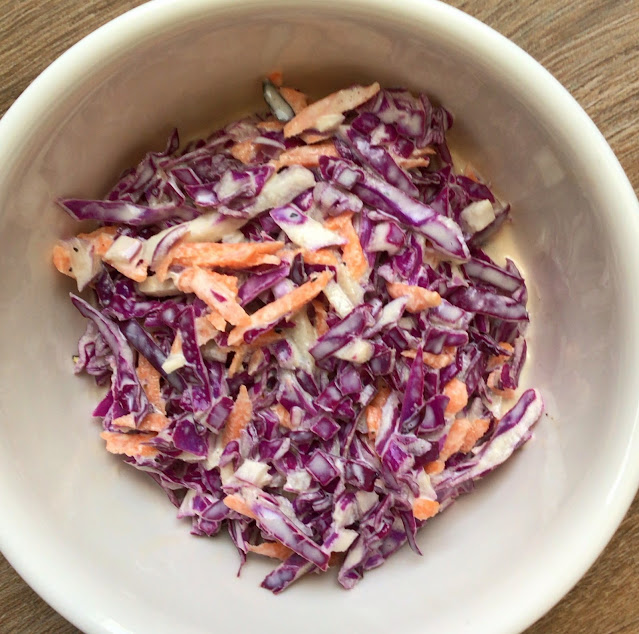
 
My food photos are getting blurrier by the day

Creamy Coleslaw

Adapted from The Food Lab (2015) by J. Kenji López-Alt

Time: 15 minutes (once you’ve salted the cabbage and let it drain)

I’ve also made this without salting the cabbage, when I used prepackaged shredded cabbage, and it was a little watery, but not too bad if you serve it using a slotted spoon.

1 pound/454 grams (~½ a large head) green or red cabbage, cored and shredded
1 large or 2 medium carrots, peeled and grated on the large holes of a box grater
2 teaspoons Diamond Crystal kosher salt
150 grams (scant ¾ cup) mayonnaise
60 grams (¼ cup) rice vinegar
¼ cup (~25 grams) minced red onion
25 grams (2 tablespoons) granulated white sugar
15 grams (1 tablespoon) Dijon mustard
Freshly ground black pepper

    1. Toss the shredded cabbage and carrot together with the salt in a colander set over a bowl. Let stand until the cabbage wilts, at least 1 hour and up to 3 hours. Rinse under cold running water. Wring dry in a clean kitchen towel, or spin dry in a salad spinner. (See note.)
    2. Transfer the cabbage and carrot to a large bowl. Add the mayo, vinegar, red onion, sugar, mustard, and generous twists of pepper. Mix thoroughly. Taste for salt, pepper, sugar, and vinegar—you’re looking for the right balance of salty, sweet, and acidic. Serve now or, better yet, refrigerate for at least a few hours to let the flavors meld. Serve using a slotted spoon to leave behind some of the liquid that’ll inevitably pool at the bottom of the bowl even if you salt the cabbage. Serves 4 to 6.

Friday, February 26, 2021

Cleaning-out-the-fridge recipes, part II

Posting two recipes in a row for similar celery salads might be the kind of thing that would lose a blogger his (very) small handful of regular readers ... but then you'd try this recipe and be (extra) grateful for said blogger. After making the Celery and Parmesan Salad twice, I just happened to read an article on the Bon Appétit website called “The Keepers: The Recipes We Cook Over, and Over, and Over Again.” Among the 19 recipes collected there was another one for a celery salad, with a separate appreciation by Carla Lalli Music (former Bon Appétit food director) with the eye-catching title “This Celery Salad Is Actually Amazing and Yes, the Main Ingredient Is Celery.”
 
And so I had to try this one too, and yes, it is most definitely amazing. Not only did Mom—having now overcome her deep-seated skepticism of celery as the main ingredient in anything—and I both pronounce it "heavenly," but I'll go so far as to say that this is one of the best salads of any kind I've ever tasted. Depending on what items you plan to keep in your pantry, both celery salads are worth having in your repertoire, but this is the one that will really impress your dinner guests—when you have dinner guests again.


Celery Salad with Almonds, Dates, and Parmesan

Adapted from Joshua McFadden from Bon Appétit (Sept. 2013) and Six Seasons (2017)

Time: 23 minutes

The leaves are a nice part of this salad, so buy a whole head of celery, rather than pre-trimmed celery hearts. If you get a very stringy bunch of celery, you can peel off the fibrous outer layer with a vegetable peeler. In Six Seasons, McFadden includes the extra step of soaking the celery slices in a bowl of ice water for about 20 minutes to “heighten the crispness,” then draining and patting them dry before proceeding with the recipe. But I think celery is already plenty crisp without this step, which wasn’t included when the recipe was originally published in Bon Appétit, so I skipped it.

65 grams (½ cup) raw almonds
8 celery stalks, with the tender leaves (see note)
6 soft Medjool dates, pitted and coarsely chopped or snipped
45 grams (3 tablespoons) freshly squeezed lemon juice
¼ teaspoon dried chile flakes, or to taste (you can use regular crushed red pepper flakes or something like Aleppo or Marash for less heat and more flavor)
Diamond Crystal kosher salt
freshly ground black pepper
55 grams/2 ounces Parmesan cheese, shaved with a vegetable peeler
53 grams (¼ cup) good extra-virgin olive oil

    1. Place a rack in the center of the oven; heat to 325 degrees. Place the almonds on a small sheet pan (a 9-by-6½-inch eighth sheet pan is perfect). Toast the almonds, shaking the pan once or twice, until they are fragrant and a shade or two darker, about 10 minutes; watch carefully. Transfer the almonds to a plate to cool, then chop them coarsely.
    2. Meanwhile, clean and trim the celery, separating the leaves and reserving. Slice the stalks on a sharp (more than 45-degree) angle into ¼-inch-thick pieces. Transfer to a large bowl with the celery leaves.
    3. Add the almonds, dates, lemon juice, and chile flakes, and toss with the celery. Season generously with salt and pepper. Add the Parmesan shavings and oil, and toss gently. Taste and adjust the seasoning; you’re aiming for a perfect balance of salty, tart, and sweet. Serves 4 to 6 as a side.

Dylan’s comments: This is “definitely a keeper,” but double or triple (!) the chile flakes and use a teaspoon or two (5 to 10 grams) less lemon juice 


Sunday, February 21, 2021

Cleaning-out-the-fridge recipes, part I

I don't expect this recipe to generate any more page views than the glazed carrot recipe I just posted, but it's worth having in your repertoire because it solves a problem that's been bugging me for a while. You buy a whole bunch of celery to make one of your favorite UaKS recipes like Lentil Stew, Gigli with Lentils, or Dried Cherry Chutney, but you only need one stalk. Then the rest of the bag sits unused in the crisper drawer in your refrigerator for a while,* until it finally goes bad and ends up in your compost bin. Well, not anymore. This recipe uses up all the rest of that celery. Mom was dubious of anything with celery as the star ingredient, but even she agreed that this dish is not just practical but really tasty too. Leave it to the Italians to solve my food problem. (In the Barefoot Contessa video accompanying the recipe I adapted below, Ina says that "Italians really love celery, and they use it much more than we do." Who knew?)

---------
* Celery will keep for up to a few weeks in the fridge, especially if you take it out of the plastic bag you probably bought it in and wrap it in foil instead before storing it in the crisper drawer.


Celery and Parmesan Salad

Adapted from Ina Garten via the Food Network (with Barefoot Contessa video)

Time: 20 minutes total active, plus 1 hour or more in the fridge
 
Celery is obviously pretty bland on its own, so the genius of this recipe is pepping up the flavor with, among other things, umami from two sources: Parmesan and anchovy paste. Having said that, you can skip the anchovy paste or come up with an acceptable substitute. The original recipe makes a ton of dressing, so I halved it. If you're not a fan of vinegar (you know who you are), this would also make a good dressing for a regular side salad. If you get a very stringy bunch of celery, you can peel off the fibrous outer layer with a vegetable peeler.

12 celery stalks, yielding ~5 cups sliced (see note)
Diamond Crystal kosher salt
45 grams (3 tablespoons) freshly squeezed lemon juice, divided
1 teaspoon grated lemon zest
53 grams (¼ cup) good extra-virgin olive oil
1 tablespoon minced shallot
½ teaspoon celery seed
¼ teaspoon anchovy paste, optional (see note)
freshly ground black pepper
a block of Parmesan cheese
65 grams (⅔ cup) toasted walnuts, coarsely chopped
a palmful of Italian flat-leaf parsley leaves, coarsely chopped

    1. Clean and trim the celery, separating the leaves from the stalks and reserving. Slice the stalks thinly on a sharp angle (bias). Place the celery slices and leaves in a large mixing bowl. Toss with
½ teaspoon kosher salt and 1 tablespoon (15 grams) of the lemon juice.
    2. In a small bowl, whisk together the remaining 2 tablespoons (30 grams) lemon juice, lemon zest, olive oil, shallot, celery seed, anchovy paste, ¼ teaspoon kosher salt, and a few good grinds of pepper. Stir the dressing into the celery. Cover and refrigerate for at least 1 hour.
    3. When ready to serve, transfer the celery to a platter, leaving some of the dressing in the bowl. Taste for seasoning. Using a vegetable peeler, shave thick strips of Parmesan over the celery. Sprinkle with the walnuts and parsley and a grind of pepper. Spoon the remaining dressing over the top. Serves 4 to 6.


Saturday, February 13, 2021

“I'm not a cat”

Nobody says we lawyers are techno-wizards. You've probably all already seen the viral video of this Texas lawyer's faux-paw, in which he attended a video Zoom hearing with his secretary's cat filter on and didn't know how to turn it off. If not, here it is:
 

The best part is the other two lawyers looking bored through the whole thing and not even cracking a smile. Humorless nerds.

The video quickly made the rounds through my work email. The best response was this one from one of my colleagues:


Hmm, sounds like my colleague is accusing the cat of purr•jury. 🤣
 
*********
 

Tuesday, January 12, 2021

The capacity to give a shit

During our car trip to Georgia and back,* Brad and I listened to multiple episodes of The Happiness Lab with Yale psychology professor Laurie Santos, which is my second can’t-miss podcast after Poetry Unbound. We listened to almost all of the “bonus” episodes from early in the coronavirus lockdown. These included lots of good information that is useful even when you're not living through a pandemic.

For example, the episode on how to coach yourself through a crisis introduced the idea of "psychological distance." Ever wonder how you can be panicked about an issue, but Mom and I can discuss it with you much more rationally and help you problem-solve? That's because, in the end, it's not our decision to make, so we can brainstorm ideas without the emotional overlay. It turns out you can gain some psychological distance from your own problems just by thinking about them in the third person, like LeBron James famously did when making "The Decision" about what team to join in free agency in 2010 ("One thing I didn't want to do was make an emotional decision. And I wanted to do what was best for LeBron James and what LeBron James was going to do to make him happy."). Dr. Santos discussed this idea with Ethan Kross, a professor at the University of Michigan who co-authored a study finding that this kind of "third-person self-talk" is a relatively effortless way for people to "think about the self similar to how they think about others, which provides them with the psychological distance needed to facilitate self control." So the next time you're fretting over a problem, don't think, "What am I going to do?"; instead, try, "What is [Brad, Cassie, Dylan] going to do?" It sounds ridiculous, but there is good science behind it.

In another episode, Dr. Santos discussed some tips for keeping your relationship healthy during the pandemic with Eli Finkel, a professor of social psychology at Northwestern who studies romantic relationships. One idea really caught my attention because it involves, in essence, bringing the "principle of charity" into your relationship with your significant other. For Dr. Finkel, one option for dealing with what you perceive could be an unkind remark from your partner flows from Marcel Proust's observation that "Mystery is not about travelling to new places but about looking with new eyes." Dr. Finkel asks, "Can we look with new eyes when we think about our partner?" He discussed promising psychological research showing that we actually have a lot of power when interpreting our partner's statements. In particular, we get to determine whether they said something because they're disrespectful and don't appreciate us, or, alternatively, because they're overwhelmed and trying to do the best they can in difficult situations. Obviously, drawing the second conclusion has different, and much better, consequences for your relationship.

While the conversations we listened to all had useful information, by far the most entertaining was with Dan Harris, ABC newsman and author of one of my favorite books, 10% Happier. In answering Dr. Santos's question about loving-kindness meditation, Harris offered his definition of "love," which is "the capacity to give a shit" about others (and ourselves). This ability is deep-wired into all of us because people needed it to survive as part of a tribe when we were evolving on the savannahs. And we can tap into this innate capacity we all have to care about other people by doing loving-kindness meditation, which the research has shown promotes compassion and psychological well-being. Like addressing yourself in the third person, it sounds like some new-age nonsense, of which Harris himself was at first skeptical, but he is now an enthusiastic proponent. In the words of a meditation teacher he quoted, "if you can't do cheesy, you can't be free."

---------
*It wasn’t the main purpose of our trip, but I did say a quiet “Thank you” to Georgia as we crossed the border from South Carolina.

*********

Friday, December 18, 2020

"Die Hard" is most definitely a Christmas movie

My buddy Ed continues to feed me blog-worthy material, this time through an email with the attention-grabbing subject line "I hope you're sitting down." The email contained nothing other than a link to an article that Ed knew would provoke me: "Jan de Bont explains why 'Die Hard' isn't a Christmas movie." Jan de Bont was the cinematographer for Die Hard, and the article is well worth a read for all of the inside scoop on how the film was shot and other matters. But the article gets its clickbait title from de Bont's opinion that “I’m not sure if the spirit of Christmas is fully embraced by that movie, to be honest. To really call that a Christmas movie — it’s a little far-fetched.” Wow, it's like the man never watched his own movie.

Let's get this out of the way right up front:
 

The movie starts with John McClane carrying a big stuffed bear through an airport on his way from New York to Los Angeles to spend Christmas with his family. The remaining 98% of the movie is set during the Nakatomi Corporation's annual Christmas party. If it's not a Christmas movie, why does John put a Santa hat and write "HO - HO - HO" on one of the bad guys he takes out? The end credits run to "Let It Snow," for Pete's sake. Sorry, Jan, Die Hard is not only a Christmas movie, it's the Christmas movie.* (And the director, John McTiernan, says so, too, in this 12-minute video explaining “how Die Hard became a Christmas movie.”.)
 
---------
*If for some odd reason you prefer less explosions and machine-gun fire in your Christmas movies, I can also recommend A Christmas Story and Miracle on 34th Street (the original 1947 version with Edmund Gwenn as Kris Kringle). If you want a redemption story, try the underrated The Family Man instead of It's a Wonderful Life  for a change.

*********

Friday, November 27, 2020

Gareth Bale

Reading articles about the Welsh soccer star Gareth Bale's refusal to take a cut in his massive £500,000-a-week wages so that he could move on from Real Madrid, where he was exiled to the bench, I thought back to the two Champions League games in 2010 when the then-21-year-old Bale crushed the defending champions Inter Milan and wondered if I'd make the same choice to get paid to sit out while my prodigious speed and skills eroded.

 
Gareth Bale

 
sits smirking and yawning in the stands with
his teammates, the same ones he disenchanted
in a particularly apathetic appearance, the last straw
for his coach, Zinedine Zidane, who never gave, and
can’t accept, less than maximum effort. Mind you,

this is the same coach for whom Bale almost
single-handedly won the Champions League final
two years earlier, impelling Los Blancos into the lead with a
recumbent bicycle kick just three minutes after coming on,
then adding the insurance goal nineteen minutes later,

the same coach who exited his last game in a red mist
before it ended, after flattening Marco Materazzi with
a precise thrust of his bald pate into the brutish defender’s
solar plexus, because Materazzi said he’d rather have
Zidane’s sister than his shirt after the match. Oh Zizou,

how cliché, but you fell for it anyway, then watched
that clown Materazzi bury his spot kick before smooching
the World Cup trophy you trudged past on your way off the pitch,
after Trezeguet missed the penalty you might have taken,
having scored one early in the match, only to be undone

by Materazzi’s (always him!) towering header. Is this
who we are? The headbutt, rather than the Golden Ball,
collecting half a mil weekly to ride the pine, just
two years removed from being the hero of Kiev?
Bashō understood that enlightenment is a path, not a

destination (which sounds like something Mom 
would say).
Relish the joys along the passage—spinning through
a Zidane roulette to avoid befuddled defenders,
bursting past Maicon down the left wing with unrivaled
speed and power—wherever it takes you.

*********

Sunday, November 22, 2020

It's a dinosaur!

At my friend Bill's urging, I recently read H Is for Hawk, Helen Macdonald's magnificent 2014 memoir about the year she spent training a goshawk in the wake of her father's unexpected death. Bill also let me know that Macdonald had just published Vesper Flights, a collection of 41 essays that she likens in her introduction to a Wunderkammer—a sixteenth century "cabinet of curiosities" or wondersbecause the essays cover a wide range of topics, most of them dealing with the natural world.

For example, in the second essay, "Nothing Like a Pig," Macdonald writes of her first encounter with a boar, which she describes like this:
When I saw Jurassic Park in the cinema something unexpected happened when the first dinosaur came on screen: I felt a huge, hopeful pressure in my chest and my eyes filled with tears. It was miraculous: a thing I’d seen representations of since I was a child had come alive. Something like this was happening now and it was just as affecting.

This was shockingly familiar to me. I've never seen a wild boar, but I saw Jurassic Park in the theater (twice, the second time while we were waiting for Dylan to be born) and that was my exact reaction to the scene where the main characters see a huge brachiosaurus and some of the other dinosaurs for the first time, while John Williams' famous theme swells in the background. I've always felt like a sap for reacting so emotionally to such a cheesy movie, but reading that Macdonald experienced the same thing, I feel ... what? Kinship? Vindication? I don't know.


Of course, they have the weaselly lawyer's first thought on seeing the dinosaurs be, "We're going to make a fortune off this place," but even that can't ruin this scene, which remains one of my favorite moviegoing experiences (right up there with this one 🤣). "Welcome to Jurassic Park!"

*********

Thursday, November 19, 2020

More voyages with porch pirates

Ahoy dear readers, I'm afraid my reputation precedes me, like a mighty leviathan trying to outrun the sting of the harpoon in the briney deep. My buddy Ed continues to feed my obsession by forwarding me every article he stumbles across on the scourge of porch piracy, and I continue to take the bait. But how could I resist such choice morsels as these?
 
The first article ("Americans lost $5.4 billion in stolen packages this year, survey finds") reports that half of the booty lost to porch piracy—$2.7 billion this year—was swindled from millennials and another $1.6 billion from GenXers, while baby boomers lost a mere $700 million. No doubt the buccaneers have realized the profit in stealing all of the North Face, Land's End, and similar merch you and all of your millennial and GenX peers are buying. If you go to the article, you will note that this freebooter was at least thoughtful and/or smart enough to wear a face covering while hornswaggling the loot—no sense giving or getting COVID-19 along with your not-so-hard-won bounty.

Alas, pirate smarts were sorely lacking from the bilge-sucking scallywag discussed in the second article ("Alleged porch pirate arrested after wearing exact same shirt to court from surveillance footage"). This line from the article says it all: "An accused porch pirate has been arrested after wearing the exact same shirt the very next day to a South Carolina courtroom that he had worn to steal packages from peoples’ porches" the day before. Not only that, but you can see from the photo that it was a North Face shirt he was wearing both days, which is prima facie evidence that he's a serial offender, having almost certainly swiped the shirt from some poor millennial on a previous voyage. So mark my words and keep up your guard against this ever-expanding menace. Savvy?

*********

Friday, October 30, 2020

More adventures in happiness

After finishing The Happiness Advantage by Shawn Achor, I've moved onto The How of Happiness (2006) by Sonja Lyubomirsky, who is one of the leading researchers on the psychology of happiness/well-being. Lyubomirsky gave center stage in the book to a pie chart depicting that “50 percent of individual differences in happiness are governed by genes, 10 percent by life circumstances, and the remaining 40 percent by what we do and how we think—that is, our intentional activities and strategies." Last year, at a talk during the 6th World Congress on Positive Psychology (how cool is that?!), she backed off that statement a bit, saying that she regrets assigning hard numbers to those three factors, but she still emphasizes that all three exert "sizable influences" on well-being. The idea remains that even though there are genetic and circumstantial components to happiness, your "intentional activities and strategies" still play a big role in how happy you are.

The book lives up to its subtitle—"A Scientific Approach to Getting the Life You Want"as Lyubomirsky takes you through the science in laying out a step-by-step approach to finding the happiness-enhancing activities you should try to increase your own well-being. You start by taking a Person-Activity Fit Diagnostic, which helps you determine which of the 12 happiness activities she describes are the best fit for you. After that, you take the Oxford Happiness Questionnaire to get a baseline for your happiness level. Then you dive into one or more of the activities that are best fitted to you and re-test every month or so to see how you're progressing.
 
It sounds like some work, but the questionnaires don't take long, especially if you do the self-scoring ones online, and it's kinda fun once you get started. The Person-Activity Fit Diagnostic certainly rang true for me, as my top four happiness activities turned out to be:
  1. Taking care of your body ("engaging in physical activity, meditating, and smiling and laughing");
  2. Savoring life's joys ("paying close attention, taking delight, and replaying life's momentary pleasures and wonders, through thinking, writing, drawing, or sharing with another");
  3. Doing more activities that truly engage you (increasing the number of challenging and absorbing "flow" experiences at home and work in which you lose yourself); and
  4. Expressing gratitude (counting your blessings for what you have, either privately, in a journal or through contemplation, or to a close other).
Lyubomirsky includes a lot more detail about the activities, and more of them to try, than Achor did in The Happiness Advantage (which is a quicker, more entertaining read). But after a month or so of doing some of the activities from The Happiness Advantage, I already scored above average on the Oxford Happiness Questionnaire, which correlates to "rather happy; pretty happy." That seems like a pretty amazing start for me.

*********